Home / The Journal / Food in Egypt: Dishes to Try on a Luxury Trip
The Journal
Food in Egypt: Dishes to Try on a Luxury Trip
Koshari, ful medames, ta'ameya, molokhia and Om Ali: the Egyptian dishes worth trying, where you eat on a private journey, and what the CDC says about water.
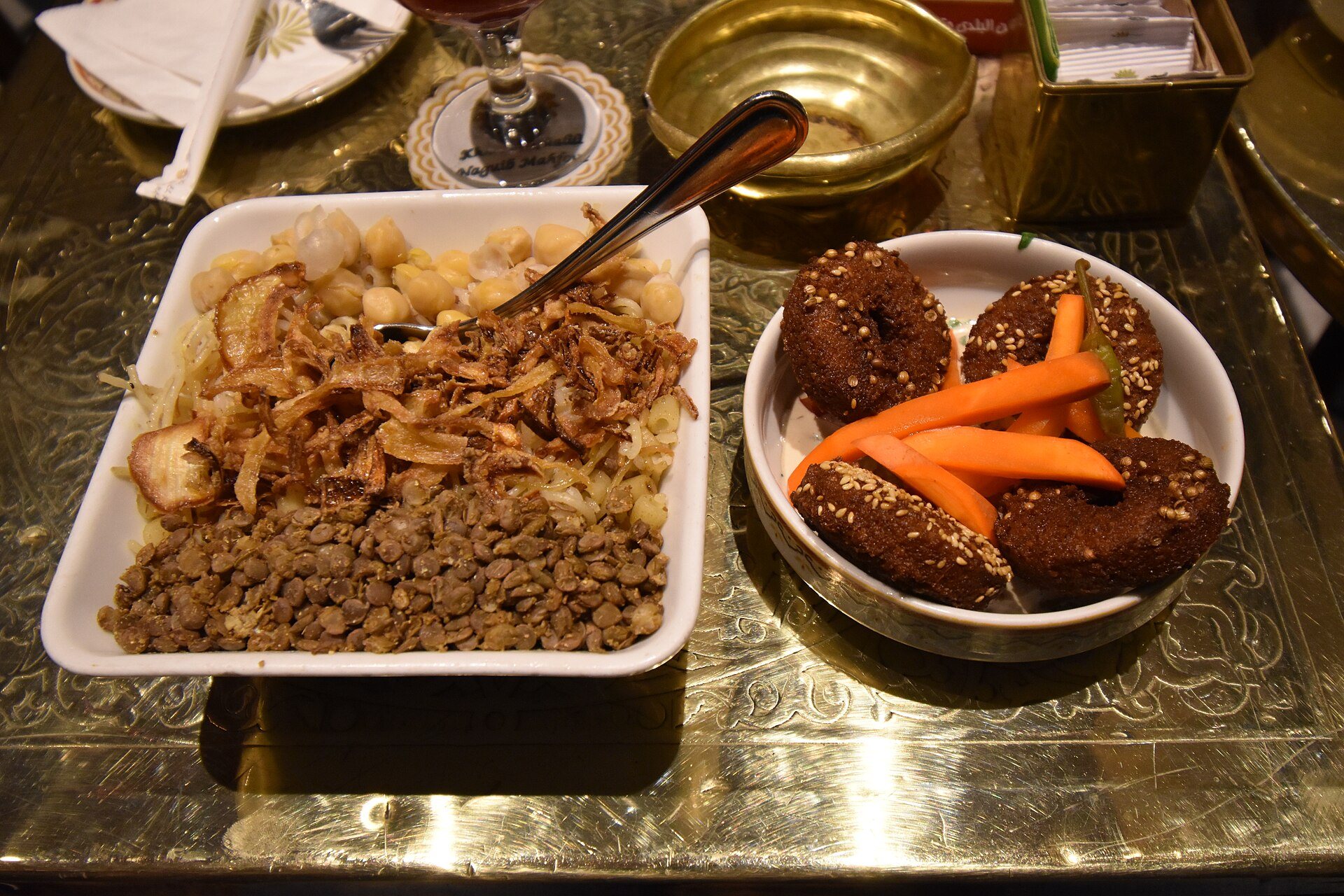
Food in Egypt worth trying starts with koshari (rice, pasta, lentils and fried onions), ful medames (mashed fava beans), ta'ameya (Egyptian falafel of fava beans), molokhia, mahshi (stuffed vegetables) and feteer (layered pastry), then basbousa, konafa or Om Ali for dessert and karkadeh to drink. On a private journey you eat in hotels, on Nile cruises with full board and in restaurants on tour.
Key takeaways
- UNESCO inscribed koshary on its Representative List of the Intangible Cultural Heritage of Humanity in 2025; calling it the national dish is common usage, not an official title.
- Ta'ameya is the Egyptian falafel: in Egypt it is typically made with fava beans.
- The CDC says tap water is not safe to drink outside international tourist hotels, and every journey on this site includes bottled water during tours.
- Nile cruises and dahabiyas on the site's journeys run on full board, and the CDC considers thoroughly cooked meat and vegetables on Nile River cruise ships generally safe.
- Dietary needs go in your request: the written proposal states which meals are included before anything is booked.
Food in Egypt: the dishes at a glance
A dozen dishes and drinks to look for, with what each one is made of.
| Dish or drink | What it is | Good to know |
|---|---|---|
| Koshari (koshary) | Rice, pasta, black lentils and fried onions, with vinegar, garlic and hot sauce added to taste | On UNESCO's intangible heritage list since 2025 |
| Ful medames | Mashed fava beans and spices, sometimes with other foods added | Ask what has been added if you avoid meat |
| Ta'ameya | The Egyptian falafel | Typically made with fava beans in Egypt |
| Molokhia | A soup-based dish made with jute leaves | Popular in a number of Arab countries |
| Fattah | Rice, chunks of lamb and oven-baked pieces of eish baladi bread under a tomato or vinegar-based sauce | A festive dish, eaten particularly at Eid al-Adha |
| Mahshi | Peppers, eggplants, zucchini, tomatoes, or grape or cabbage leaves stuffed with seasoned rice | Cooked under chicken or beef broth |
| Feteer | A flaky, layered pastry made with samna | Sometimes described as an Egyptian pizza |
| Basbousa | A semolina cake soaked in syrup, usually topped with almonds | Traditionally cut into diamond-shaped pieces |
| Konafa | Layers of filo pastry wrapped around a sweetened cream or cheese filling | The Egyptian version of kunafa |
| Om Ali | Puff pastry soaked in sweetened milk, topped with nuts and golden raisins and baked | The name means Mother of Ali |
| Karkadeh | A tea of dried hibiscus | Usually served very sweet and cold, sometimes hot |
| Juices | Sugarcane, carob and seasonal juices of mango, guava and doum palm fruit | See the CDC's water advice below |
Koshari and the national dish question
Koshari, also spelled koshary, is built from simple, affordable ingredients: rice, pasta, black lentils and fried onions, with vinegar, garlic and hot sauce added according to preference. In 2025 UNESCO inscribed koshary, as a daily life dish and the practices associated with it, on its Representative List of the Intangible Cultural Heritage of Humanity.
You will often read that koshari is Egypt's national dish. That is common usage, not an official title; the UNESCO listing is the formal recognition.
Savory dishes beyond koshari
Ful medames is a dish of mashed fava beans and spices, sometimes with other foods added. Ta'ameya is the Egyptian falafel, and in Egypt it is typically made with fava beans.
Molokhia is a soup-based dish made with jute leaves, popular in a number of Arab countries. Mahshi is a family of stuffed vegetables: green peppers, eggplants, zucchini, tomatoes, or grape or cabbage leaves filled with rice seasoned with tomatoes, onion, parsley, dill and spices, then cooked in a pot under chicken or beef broth.
Fattah is a festive dish, eaten particularly at Eid al-Adha: rice, chunks of lamb and pieces of eish baladi bread baked in the oven, all covered in a tomato or vinegar-based sauce. Coptic families also serve fattah at the festive meal after the Christmas Eve liturgy. Feteer is a flaky, layered pastry made with samna and sometimes described as an Egyptian pizza; at its simplest it comes plain with honey, molasses and ashta cream, or with a dip of salty mish cheese.
Sweets and drinks
Basbousa is a semolina cake soaked in syrup, usually topped with almonds and traditionally cut into diamond-shaped pieces. Konafa, the Egyptian version of kunafa, wraps layers of filo pastry around a sweetened cream or cheese filling. Om Ali, whose name means Mother of Ali, is a bread pudding of puff pastry soaked in sweetened milk, topped with nuts and golden raisins and baked in the oven.
Karkadeh, a tea of dried hibiscus, is particularly popular; it is generally served very sweet and cold, though it may also come hot. Other drinks to look for are sugarcane juice, carob juice and seasonal juices made from mango, guava and the fruit of the doum palm. For wine and beer, see our guide to alcohol in Egypt.
Where you eat on a private journey
On the journeys on this site, hotel nights include breakfast, Nile cruises and dahabiyas run on full board, and other meals are those listed in each itinerary, served in good restaurants. On a dahabiya the setting is part of the meal: the Egypt by Dahabiya journey includes a dinner by a campfire on the riverbank and describes lunch on the sundeck.
Dinner on board and in heritage hotels is also where dress comes into it; our guide on what to wear in Egypt covers cruise dinners setting by setting. If there are dishes you want to try, say so in your request: the written proposal sets out what is included and what is not.
Vegetarian and other dietary needs
Several everyday dishes are built on plants: koshari on rice, pasta, lentils and fried onions, ful medames on fava beans and spices, and ta'ameya on fava beans. Others are not: mahshi is cooked under chicken or beef broth, and fattah is made with lamb. When an ingredient matters to you, ask how a dish was made.
Plant-based eating also has a place in the calendar. Before Coptic Christmas, fasting Copts eat no meat or other animal products for 43 days, beginning 25 November, though fish is allowed. Tell us about vegetarian, vegan, allergy or other needs in your request, so the proposal is written around them.
Eating during Ramadan
During Ramadan many restaurants and cafes stay closed until iftar, at sunset, while hotels and tourist-focused restaurants stay open. Non-Muslims do not have to fast, but the UK government advises that eating, drinking or smoking in public during daylight hours is culturally insensitive at this time.
Water and food hygiene: what the CDC says
The US Centers for Disease Control and Prevention (CDC) says that in most large international tourist hotels the tap water is adequately chlorinated, but bottled water is generally provided for drinking. Outside those hotels tap water is not safe to drink, because it might come from private water tanks not audited by the Ministry of Health. Every journey on this site includes bottled water during tours.
On food, the CDC says that eating thoroughly cooked meat and vegetables in tourist hotels, on Nile River cruise ships and in tourist restaurants is generally safe. Raw or undercooked meat and shellfish should be avoided, the safety of uncooked vegetables and salads is questionable, and the risk of travelers' diarrhea in Egypt is high. In the heat, the CDC also advises eating and drinking regularly.
For vaccines linked to food and water, the CDC recommends hepatitis A vaccination for unvaccinated travelers one year old or older and typhoid vaccination for most travelers. A travel clinic can advise on your own needs before you go.
Questions travelers ask
What is the national dish of Egypt?
Koshari is often called Egypt's national dish, though that is common usage rather than an official title. It combines rice, pasta, black lentils and fried onions, with vinegar, garlic and hot sauce added to taste. In 2025 UNESCO inscribed koshary and the daily practices associated with it on its Representative List of the Intangible Cultural Heritage of Humanity.
Is it safe to eat salad in Egypt?
The CDC calls the safety of uncooked vegetables and salads in Egypt questionable and says the risk of travelers' diarrhea is high. It considers thoroughly cooked meat and vegetables in tourist hotels, on Nile River cruise ships and in tourist restaurants generally safe, and advises avoiding raw or undercooked meat and shellfish.
Can you drink tap water in Egypt?
Not outside international tourist hotels, the CDC says, because the water might come from private water tanks not audited by the Ministry of Health. In most large international tourist hotels the tap water is adequately chlorinated, but bottled water is generally provided for drinking. The journeys on this site include bottled water during tours.
Is Egyptian food good for vegetarians?
Several staples are built on plants: koshari on rice, pasta, lentils and fried onions, and ful medames and ta'ameya on fava beans. Others are not: mahshi is cooked under chicken or beef broth and fattah is made with lamb. Mention vegetarian or vegan needs in your request so the proposal reflects them, and ask how a dish was made.
What desserts should you try in Egypt?
Basbousa, a semolina cake soaked in syrup and usually topped with almonds; konafa, layers of filo pastry around a sweetened cream or cheese filling; and Om Ali, a baked pudding of puff pastry soaked in sweetened milk with nuts and golden raisins. Feteer, a flaky layered pastry, can also be eaten sweet, with honey, molasses and ashta cream.
Are meals included on a Nile cruise?
On the Nile cruises and dahabiyas in this site's journeys, yes: each runs on full board, and the CDC considers thoroughly cooked meat and vegetables on Nile River cruise ships generally safe. Hotel nights include breakfast, and other meals are those listed in each itinerary. The written proposal sets out exactly what is included before anything is booked.
The Journal
Keep reading.
 The Journal
10 Days in Egypt: A Luxury Itinerary, Day by Day
Ten days in Egypt three ways: a Nile cruise with Abu Simbel, a dahabiya from Esna, or palace hotels with a short cruise. Each one day by day, with where you sleep.
 The Journal
7 Days in Egypt: A Luxury Itinerary, Day by Day
Seven days in Egypt, day by day: where you go, where you sleep and which ship sails the 3-night cruise, plus the 8-day version with 4 nights from Luxor.
 The Journal
An Egypt Honeymoon in Luxury: How to Plan It
A luxury Egypt honeymoon works when the pace is slow: a dahabiya or small ship on the Nile, a night at the Old Cataract in Aswan and a few days on the Red Sea.